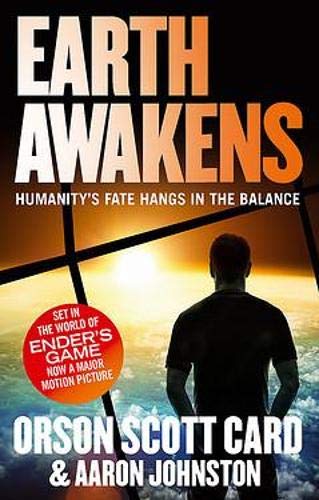
Many years ago (but in this same galaxy) an author visited my small high school to advertise his books, sell and sign them if asked, and importantly to encourage reading. As a young reader of fantasy and science fiction I gave his book a go. Ender’s Game by Orson Scott Card was amazing and I’ve been a fan since. Card and his co-author Johnston decided to move backwards in time in their new series, prior to Ender and Shadows and everything else we knew. Or thought we knew.
Earth Unaware
The First Formic War
By Orson Scott Card and Aaron Johnston
Tor / Macmillian Audio
July 2012
The story opens with young Victor Delgado and his family – read clan – on board a free mining ship, El Cavador. Our first introduction to this harsh life on the frontier of the asteroid belt is of love and love lost. But our focus on youthful passions is eclipsed very quickly by a message from the ship’s Eye (sensor/ radar) that shows a ship moving in to the solar system as impossibly fast speeds and from impossibly deep space – space where no humans exist. Is it a threat to Earth, the planet it is directly heading to? It certainly seems so. And so the race is on between humans and this alien contact to get news to Earth so they can prepare for the possible invasion.
What’s great about this story is that it is so very grand in its scope. There are characters on the edges of the solar system, back on Earth, on the moon, on other planets and asteroids and on other ships; there are free minors scraping out a living on junk ships, corporate billionaires on science vessels, and security forces in India. But this isn’t Star Wars so there isn’t this “hyper speed” option that can quickly move our same characters to different locals. This slow pace of travel adds to the vastness of the solar system in ways that many science fiction books just can’t convey.
Also, the characters in the different places aren’t merely functionaries to move our story forward but are actually a part of the story that in this book only begins. How do the special forces on Earth fit into the story of Victor Delgado? We won’t know until later books in the series. Yet, these soldiers play a huge part in setting up the stage, expanding it and making it much, much more than your average story. Some could even argue that Victor isn’t really the protagonist of the series; there are so many interesting leads.
Some early reviews wonder about the need for a prequel and what they call questionable physics. Would this be a Star Wars Episode 1 –like blunder? Absolutely not. In fact, this seems like the best kind of prequel. The kind that you could start the story with and with consistency move through this series to the Enders series’ to conclusion. Like all good things, more is better.
As for the physics, I wondered myself about the questions of inertia, acceleration and deceleration while in a vacuum. I spoke to a friend of mine who has a physics degree (and is a published Science Fiction writer as well) and found that the parts in the story where Victor struggles with these movement type issues (I won’t give it away) are plausible. “Any time there is acceleration, one will experience g-forces.” He said so the black outs would be possible. My friend said that there is such a thing as the “equivalence principle” an important part of Einstein's theory of General Relativity that “demonstrates an equivalence between the force experienced by a stationary body in a gravitational field and a moving body in an accelerated coordinate system that is not in a gravitational field. And at a simpler level Newton's second law reminds us that mass x acceleration is equal to force.” For those of us who have no idea what that means, here it is: the mass of the ship (plus supplies and Victor) times the acceleration of the ship is equal to force. So Card and Johnston are good here. Complains about physics like this are rather nitpicky anyway considering that these authors are writing in the same genre as that of Star Trek with its warp speed and beaming and Star Wars or Battlestar Galactica with FTL engines, none of which are possible as of yet (and where some of these technologies are considered impossible).
As a space opera this book fabulously achieves its goals. This is a grand scale science fiction book that fans of Card and his previous books as well as fans of science fiction ought to pick up. I highly recommend it.
A note about the audiobook: This book is narrated by several different readers, male and female, which adds to the magnitude of the story. Each reader does a very good job with character voices and conveying emotion through their portion of the story. The only (small) thing I'd like to have seen change was that by the end of the book we start to get many more perspectives and the readers were recycled and used for more than one character arch. If we could have had different readers for all the characters I would have preferred that. Small request for such a well done production.